About me

Welcome to my blog. Im always looking for new ways of bringing people together to build campaigns. Im always amazed by the energy and passion of the people I meet and the different skills they bring to making change happen - the ideas we try out, the campaigns we work on, the relationships we build together. I want to share those stories with you. I hope you enjoy them!

Contact me

You've got an idea or activity that you would like to develop, an issue that matters to you or would just like to find out more? Contact me now by email, twitter, or facebook.

Showing posts with label developing ideas. Show all posts

Out of office, out of sight, out of reach - Generation Why?

I remember walking into a briefing on the Erasmus scheme while at university. I remember thinking this scheme reflected the principles of the European Union - uniting Europeans from all backgrounds behind a common identity by creating it together. The film, the "Auberge Espagnole", itself epitomised this Erasmus experience of what the European good society could look like. But did it really reflect how young people lived their lives in the noughties?

What else united young Europeans? More and more us got places at university, more and more us got into debt paying for tuition fees and more and more of us were betrayed by the myth that graduates would get graduate jobs. The only bar we had a chance of practising at was at the local pub, bistrot or discoteca. All we've done is wait. Wait by the phone in the hope of a job, wait restaurant tables to pay the bills and wait in the queue for the dole.

For those who of us who couldn't get into university, we were promised that employers preferred vocational skills to degrees, so more and more of us took up apprenticeships. The only vocation that united us was trying to hard to please the employers who ignored these new diplomas and preferred recruiting from their old boys networks.

To stop the rise in youth unemployment, governments traded off our wellbeing with employers by allowing them to pay us as little as possible. In many cases we were paid less than the minimum allowed, providing loopholes for the most powerful professions - accountants, lawyers and politicians - to recruit first class talent on pocket money wages. Despite our governments' blind belief in economic growth, wages in relation to the cost of living fell. We became the "Generation Precaire".

And now the recession's turned up on our doorstep, young workers are the first to be shown the door. Youth unemployment has shot up across the continent - between 30 to 40% of young people are out of work in most of Europe and that's not even including all those who graduated this autumn and have just joined the queue.

We may look back at the noughties and forget the fads that came and went - from Big Brother to X Factor - but we won't forget being unemployed even when we get older. Not being in work means we lose valuable experience and training and even when we get a job, we're going to go back to the cycle of low self esteem and lack of job security, low wages and lack of career advancement.

As a generation, we don't know where to turn back to. Like other under-represented groups in the places of power, young people are marginalised. In politics, we are too often restricted to "youth issues". In the economy, we are treated as ideal bait for consumption. In society we are asked to wait our turn, we are the "next generation", but next never means now.

It's partly why we are least likely to take part in the structures defined by the generation that preceded them - such as political parties and trade unions. With the crisis we face, people are crying out for a new way of doing politics. It's not that young people aren't interested in politics, it's that they see no way of being able to make change happen.

That's why so many are refusing the compromises of the centre left and putting their trust in the parties on the fringes - from the greens to the far left, just look at the recent election results in Germany and France. Many more aren't even bothering to vote and instead taking to the streets to fight the marketisation of their education, storming the runways to make sure future generations don't pay the price.

Our grandparent's generation fought and got the welfare state, our parents took to the streets for individual liberties. The challenges for our generation can only be solved by working together across borders. Only doing this can provide us with a decent future across Europe.

Noel Hatch is the National Chair for Compass Youth and co-author of "Radical Future, Politics for the Next Generation" (Soundings, forthcoming April 2010).

THE RESOLUTIONS WON'T BE TELEVISED

I’ve been reflecting on some of the trends of 2009 and thinking about what New Year’s resolutions public services could start thinking about.

Thanks to digital technologies, more people are creating content and collaborating online in ways that weren’t possible before.

If we want radical efficiencies, it can’t be about doing the same for less, but about doing things differently and better, as well as measuring what matters.

If we look at where the web is most successful at driving social change, it’s where it mobilises untapped resources – people’s energy and innovation – for mutual benefit. It’s what we could call the gift economy.

So what’s this all about? When you receive gifts for Christmas this year, you don’t pay them the amount it was worth. At the same time, if you stop giving gifts to friends, you may find there’ll be less inclined to give you a present.

Our relationship with our citizens is different – it would be like offering a gift to a random person in the street, they wouldn’t necessarily return the favour.

So we need to find how to create relationships with people to mobilise their intrinsic motivation. Relationships affect how people behave and how they’re motivated. Transformation in society doesn’t happen when it adopts new tools, it happens when it adopts new behaviours.

That’s why developing approaches that gain a better understanding of these trends can help us find the innovators we want to work with.

Why not use techniques like relationship mapping or social network analysis? These could enable you to find people innovating to meet the needs of your customers, and they may even be working in your office.

Listen and make sense of stories

You might be able to find who’s been involved in an innovative project before that’s saved time and money but how do you come up with an innovative idea?

When someone asks you for an innovative idea, many of us feel put on the spot. Often, it’s informal conversations that spark off ideas. It’s what’s called the “water cooler” effect”.

Yet we don’t congregate around the water cooler to bounce off ideas, we go there to catch up and share stories about what’s been going on in the office – trying to get our heads around something or solve a difficult problem.

There are various ways that digital technologies are enabling that, not just in the office like micro blogging or communities of practice but also in our local communities with social reporting. It’s because people want to share their stories of what’s going on where they work or live.

So we’ve got stories and we’ve got data on what’s going on in our local areas – but how do we make sense of it all? It’s not just about evidence or consultation was carried out last year, it’s about what data and conversations people have been publishing to the web last night.

Why not use tools that can help you visualise all of this information to pick up new trends as well as open your expertise to the public so they can make better decisions on areas that affect them? With these tools, a picture quite literally is worth a thousand words.

Why not also use tools that enable people to re-use your public information and customise it create their own online information services in ways that suit them?

Get people together to make stuff that matters

So now we’ve listened to people and made sense of their networks and stories, we can start building relationship and mobilising people’s resources, their energy, creativity and goodwill.

Digital technologies make it easier to mobilise these resources. They also bring substantial opportunities for individuals, businesses and other groups to create innovative models to meet these new demands.

These models can be found in very niche web services like Enabled by Design or MyPolice. Both of these haven’t just created new models that wouldn’t have been possible before, they’ve exploited the power of the web to create approaches that offer a form of public service.

What’s more important is they weren’t created by councils or businesses – they were created by groups of people in their spare time. You might think, why would anyone want to do that? I asked the creators of both of these services.

So we can create an environment that nurtures the capacity for innovators to develop and take these models to scale.

Who not bring people together to develop prototypes of online services that meet specific challenges in just a day?

Join up the dots to involve everyone

We may have mobilised the innovators to help us tackle problems, but the strength of innovators is often at the edge of what we do, not at the centre, so how do we scale up innovations so that the wider public can benefit, especially those not online?

Why not reach out to local innovators who can use the web to help people help each other offline, so that the opportunities that digital technologies bring meet those that community engagement bring.

Transform services by transforming ourselves

The following quote captures the lesson I've learnt over 2009. "Transformation isn’t just about transforming services, it’s about transforming ourselves, it’s a new way of thinking, it’s a new mindset."

The challenge for all of us is to harness all those people in public services and the community who are intrinsically motivated to make things better – to make stuff that matters.

KEEP YOUR COINS, WE WANT CHANGE!


A couple of friends and I have decided to organise a rather last-minute stunt to raise awareness about the Copenhagen talks on 6-18th Dec and The Wave march on Saturday 5th Dec.

We're calling on all buskers / musicians / street performers / out of work actors / photographers to take to streets in the lead-up, and instead of busking for money, to provide passers-by with entertainment and flyers to raise awareness. Hence the (borrowed) name, "Keep your coins, we want change!"

The aim is to try and inspire a decentralised thing where people can just go and do it in whichever town or city they live on whatever day they're free. However, we also want to gather a group of people in London on the weekend of 28/29 November and spend an hour or so busking and spreading the word.

Although we are particularly looking for musicians, we also need flyerers and photographers. So noone is free from the invite. ;-)

If you are interested in helping, here are a few things you can do:

Sign up to the Facebook event

Follow us on Twitter

Add to our collaborative Spotify playlist of busking songs

Let me know if you can make it on the 28th/29th Nov

Spread the word!

As you may have guessed, this is a bit of an experiment. However, it also feels like something that could just spark an interest in the wider public, something that The Wave, and climate discussions drastically needs.

So, if you wanna get on board, get in touch, or forward this to all your friends!

Many thanks,

Becky

Do you have a story to tell about how you're using exciting campaigning techniques to make a difference to the issue you care about? Let me know!

Drop outs or start ups? Next generation social entrepreneurs

The more there will be people losing their jobs, the more there will be people with more time and less money.

What can young people do with their time and energy if they've got no job to go to? How can they spend their time more creatively? Can young people out of work be the next generation of social entrepreneurs?

We don't know...That's why we want you to come and tell us what ideas we should campaign on to tackle youth unemployment. That's why we want you to come to the first of a series of sessions focused on different ways young people out of work can develop their skills.

As well as being able to have your say in shaping our priority campaign for 2010, you'll be able to hear from an amazing trio of social entrepreneurs, David Floyd (Social Spider), Peter Ptashko (Young UnLtd) and Amisha Ghadiali (Amisha/The Hub) who'll share their stories.

Sign up here!


Events

COMPASS YOUTH GOES CLIMATE CHIC!

You told us about your "green" ideas, from carbon taxes, green jobs to school gardening. Do you want to have your say on how to campaign on climate change and do something about it with others where you are?


If so, come and join Compass Youth & Change is Coming (ChiC) at "SWaP your Story" on Monday 19th October 6.30-8.30 pm at the Railway Tavern, Liverpool St (London).


Tell us why the environment matters more than ever in the recession. Find out how you can make change happen where you are with other activists and groups. Try out exciting techniques so you can get other people involved in the environmental movement.


Don't miss out, book your place now!


This workshop is open to all activists, whether you want to share your environmental involvement or if you want to make their first steps. Sign up at http://swapyourstory.eventbrite.com


Any questions or want to find out more? Email us now! If you can't see the video below, click here.


The only change worth fighting...


We don’t just listen to what you care about, we work with you so you can do something about it together. Because I know if you give people an inch, they'll give you a mile. That’s why I invited one of our activists Becky to run our first ever session on the environment.


Becky runs Change is Coming (ChiC), which encourages increased recognition of the power and responsibility of individuals in responding to and initiating change, through the use of creative & collaborative action. ChiC's primary venture is EnviroWiki.org.uk - a collaborative mapping directory compiling activity & debate for the growing environmental movement.


...It's time to get ChiC


You may be concerned about the threat of climate change, but find it hard to communicate it in times of recession and financial uncertainty. You may want to get involved in the environmental movement, but feel unsure where to start. You may just want to find out more. Either way, come and join us at SWaP the Story!


Noel Hatch

National Chair

Compass Youth

www.twitter.com/compassyouth

www.compassyouth.org

stop the excess express

I watched Fox News for the first time last night. In a nutshell, along with occasional expert advice from our friend Dan Hannan, they try and make people believe that there’s a socialist conspiracy to take over the world. If only, I thought... And then something struck me maybe there is…
  1. We had a Republican president going all socialist by providing around $1tn to bail out financial institutions so that the economy didn’t go bust.

  2. We had Wall Street falling in love with nationalisation because it's all they had left.

  3. We’ve got the Lord who runs the agency regulating financial services supporting the iconic Tobin Tax pledge of the anti globalisation movement.

  4. And now we’ve got the conservative duo Sarkozy and Merkel making the running to tame excessive pay and bonuses in banks.

I never realised there were on our side! And then I realised they tried to convince us they were when they expalined how the excessive greed of the other “masters of the universe” was somehow contributing to the economy. “Yes we can” they all must have said when they gave themselves bigger and bigger bonuses, higher and higher pay.

So it does feel slightly strange that many people now applaud the Establishment for calling for policies which were deemed too radical when those less in thrawl to the City called for them?

As Jackie Ashley comments, “If everyone is a member of the soggy centrist consensus, serious thinking becomes flabby and the point of parliamentary politics declines…Who can now say that the iron discipline of New Labour MPs during the boom years was such a good thing? If it meant that there was very little probing of the City and banking practice, wasn't that a mistake?”

There was (is?) as much iron discipline by MPs towards the City as there was towards their party whips. From all sides of the house. While we warned that the excessive greed of the fat cats probably affects social cohesion more than a teenager spraying graffiti on your wall, the government are still giving out ASBOs to kids and letting bankers at government-controlled banks give themselves bonuses.

But let's move beyond the "we told you so" (we did…he did even earlier) and look at how we can get out of this mess.

There are many proposals around proposing maximum wage ratios or bonus taxation. Of course these all need to be considered and the thread that brings these all together is the urgent need to review excessive pay across the board.

Now that doesn't sound too radical does it? Well…no actually, as 65% of the public polled here agree we need a High Pay Commission that would do exactly that. OK, so surely all those people must have been socialists? Well…no, as 66% of Labour voters are up for it, but so are 63% of Tories and 75% of Lib Dems.

So are we going to wait for other “masters of the universe” to tell us what to think or are we going to start rocking the boat for the right reasons?

stop agonising, start organising

You might think that things couldn't get any worse after finding out politicians claiming to represent us are using taxpayers' money to build houses for ducks rather than homes for people and a government preferring to attack each other than attack the recession. With Big Brother back on our screens, it's like going from one reality show to another.

But in the real world, people are getting sacked, evicted and left on the scrapheap of the recession. And young people are getting hit the hardest, with unemployment rates much higher than other age group in "last to join, first to leave" jobs. These aren't just passing concerns but "permanent scars" even going as far as damaging their physical and mental health.


So rather than choose which sides to take in the political football games going on in Westminster village, isn't it time to stop agonising and start organising? To choose to campaign to fight the recession where we are, whether that's neighbourhoods, our campuses or our workplaces?


You may have set up an online group because you were getting ripped off. You may have invited people to a campaign session so people can live better off. You may have written to your MP to support the campaign you care about the most. You may have pitched up your tent to prevent the world turning to toast.


You may have stayed at a shelter to help the homeless. You may have gone down the beach to clean up the mess. You may have taken part in a flashmob to show people how exploitation of young people at work just isn't right. You may have marched through the streets to reclaim the night.


You may have been a street captain spreading hope not hate, you may have interviewed the wild and wonderful to instigate debate. You may have got into a bath of baked beans to raise money for comic relief...Or you may not have got involved with any of these.


Whether you've been involved in organizing before or not, you're might be curious about how to campaign and who knows even fired up about an issue you'd like to campaign on. There is no right or wrong way on how to turn an issue you care about into a campaign - just look at the examples above and you can see all the different and exciting ways people have gone about it.


So just imagine if you could bring together people who are campaigning in their communities, people that are getting their voice heard in the media and those using new and creative tools to put this in action.


Just imagine if you could work with each other to develop exciting ways to campaign, finding out how others are organising and creating the spaces where activists with different skills involved in different groups can affect real change together.


We have all been to conferences where most of the time the only way we have ever got input into our events is over a drink down the pub. Don't get me wrong, I'm still keen on having those sideline chats at the end of the bar, but there are probably other ways which are just as exciting.


That's why we've joined up with TUC Young Members and Toynbee Hall to launch a weekend to fight back against the recession.
On Saturday 20th June, you'll be able to get together into groups to discuss what impacts the recession is having on young people and what the Government should be doing in response. You'll then be able to put forward ideas on how we might more effectively organise and campaign for the rights of young people in and out of work.

On Sunday 21st June, we'll share grassroots stories from local campaigners, get together with facilitators so you can develop your skills on new campaigning techniques. You'll be able to get involved with other young people in trying these out to create new campaigns together to fight the recession.
We want the workshops to be driven as much by the people taking part as the speakers facilitating, as much by the intensity of developing a campaign in such a short space of time as the excitement of activists with such a diversity of experiences - working together to tackle issues which matter to you.

We do want to produce something at the end of the day however and although it will be intense, ultimately you'll have developed a campaign that you can take away together and take forward across your networks.


So let's dive right in, get our hands dirty and start campaigns - let's help people create change for themselves, from the grassroots up.


It's time to take back our future, it's time for you to take back your communities.

Noël Hatch, National Chair, Compass Youth


To take part and find out more about our activities next weekend, please go to www.compassyouth.org or contact noel.hatch1@gmail.com

treat yourself to a milky bar - is it time for a citizen's income?


In the recent Budget proposals, it was announced that children would get an extra £20 Child Tax Credit from April next year. The Chancellor highlighted that a third of a million families would get an average £35 a week more through tax credits. Given that nine in every ten families already qualify for tax credits, you could argue that’s good news. However, campaigners argue that amounts to an extra 38p a week to the three million children living in poverty – this was more a “milky bar budget” for them than a “people’s budget”…

So should we campaign for an even greater increase in tax credits then or would more of the same still prevent families climbing out of the poverty black hole?

We know that although financial equality doesn’t directly guarantee social equality, income inequality certainly aggravates other inequalities we face as The Spirit Level demonstrates. Despite the increase in tax credits, the proportion of wealth has fallen for the majority of us as much as it has risen for the richest 10% since the earlier 90s.

Up until now, the government has focused much more on opportunity much more than equality – it even has a name for it - “social mobility” and the most visible example of this is their approach to “getting people back into work”. The paradox though for the people that take this up is that they fall into a trap – they lose most of their benefits – housing & council tax as well as job seekers allowance while the rate of deduction of their tax rates rises significantly. This obviously discourages people from trying to get back into work, as well as the practical difficulties of being able to afford to get to job interviews or even broadband to search for jobs.


How will they be able to pay for the bills at the end of the month, not knowing how many hours their recruitment agency will give them to work and facing a sharp decrease in tax credits that takes place when you get a job?


Those who suffer the most are families with children – they experience marginal deduction rates of over 60%. The only benefit which reduces child poverty and does not contribute to deduction rates is Child Benefit. On the other hand, those benefits which increase the likelihood of entering a “poverty trap” are Working or Child Tax Credits. The difference between child benefit and tax credits is that the former is paid unconditionally and the latter is means-tested. In these times of change we can believe in, we would normally look to Obama, but the US is so far behind in terms of social protection, that it doesn't make sense this time round to be inspired. What we surely need then are more unconditional and non-withdrawable and less means-tested benefits to tackle child poverty?


How about a citizen's income?


A “citizen’s income” pushes all these buttons, so should the government need to reduce tax credits to pay for a “basic citizen's income” to everyone or should it increase taxes for those who earn more or even introduce a maximum wage to pay a “living citizen's income”?


What are the overriding benefits of a citizen’s income?


The Citizen’s Income Trust argues that it’s unconditional, so it would also reduce the stigma attached to means-tested benefits. Its non-withrawable, so it would also reduce the stress attached to working out how much they would be left with at the end of the month. It’s redistributive as income is redistributed from people who are better off more towards those less so. Those who earn the least would get a quarter more in come than they currently do, while those who earn the most would only get a bit less. The rest of us would either get an increase in income or would stay in the same position as we are now. It's empowering as it would also encourage more flexible working, lifelong learning and retraining which is so important at the moment.


A survey amongst MPs shows that there is support expressed right across the political spectrum that everyone would gain from getting a “citizen's income”. If we don’t want to turn back on our pledge to reduce child poverty by half by next year, we need to do better than the “milky bar budget” we got a few days ago. Isn’t it time for a citizen’s income?

Thanks to Cliph for the photo published under Creative Commons

no turning back!


The leaders of all three main parties want us to turn back as soon as possible to the failed ideas of the pre-crash. We think this would be a huge mistake; with this in mind Neal Lawson and John Harris have written a major essay to kick start a national debate about our country's future: Polly Toynbee" > wrote about this over the weekend and now we want you to join the discussion!

New times demand new politics. If we don't want to turn back to the old political economy of market fundamentalism then we need a conversation with individuals and groups who want to build a better society: not just the Labour movement but NGOs, faith groups, Liberal Democrats, Greens and others - aimed not at any kind of electoral pact, but a popular movement that could shift the terms of debate and reconnect politics and real life. Both Neal and John are committed to Labour as a necessary vehicle for advancing progressive politics - but know it must be transformed and forge alliances with others if it is to bring about meaningful change.

This has implications for Compass. Is this the right approach, what does it mean politically and organisationally? The truth is we don't yet have all the answers. But we want to know what you think. More than anything we want a conversation about these historic times. Please post any views you have on this news item and/or email Neal.

The article suggests 10 policy ideas to ensure we don't turn back - are these right? Please add your ideas to the How to Live In The 21st Century policy competition.

Crucially it is incumbent on all of us involved in Compass to organise and bring together all those who don't want to turn back to the ideas of the past: to stand up and say ‘enough is enough' it is time for something better.

To start this process today we've launched a No Turning Back video (please watch it with the volume on). We think it's quite inspiring and we want you to send it to everyone you know. We need more people to be part of our No Turning Back network - so please forward the video on and at the same time urge people to join our email list.

Then on Tuesday 31 March from 6pm, just a few days before the G20 summit, we've organised a No Turning Back debate in Parliament, both Neal and John will speak with Polly Toynbee chairing: we hope you can be there.

Furthermore we can now announce that Saturday 13 June will be the day of our National Conference - it will be the No Turning Back event of the year. This is where the coalition for real change will come together to discuss and debate how we build a new political economy for the 21st century. Put that date in your diary now!

Through the autumn of 2009 we will then be holding No Turning Back meetings and events across the UK. We want a meeting in every town and city. If you want to help organise a meeting please let us know.

These are critical times for everyone involved with Compass - the windfall tax campaign and now the battle to modernise not privatise the Post Office and Royal Mail are big issues we can and must win on. Now more than ever it's time to make the case that there can be No Turning Back to the failed ideas of yesterday - we hope you'll get fully engaged in the weeks and months ahead.

Download the New Statesman essay as a PDF (including 10 point policy plan) (4MB)

Read the No Turning Back essay

in government we trust?


Something that stood out from the debate "in government we trust?" was the question - what happens when we unleash the free market? Think about the pharmaceutical industry and you'll see that the market there will always survive, but in many cases customers don't (like if we don't provide free access to generics). The private sector will always walk away, but the government can't and the citizens are stuck either way. I'd also like to pull my woolly hat off to the man like Crudddas - great facilitation of the debate, almost like being in his surgery, with the added populist bonus of a vote at the end. Next time, let's push people out of their narnian comfort zones and move beyond the nationalisation-privatisation debate (which the speakers did, although the audience did't follow them, I guess Narnia's a warm place to be in the winter...). Let's ask how much centralised nationalisation do we really want without it smothering the space for innovation and the human touch by staff and the users they work with? Even if we have FDR style infrastructure projects, it's very likely that "public sector industry" multinationals will just walk away with the cash and come back when they've spent it all on peerages or consultants. This also brings us to the debate around public sector ethos and how it's being pervaded by the private sector (esp now with the financial sector having swallowed itself up). If we get stuck at stopping public services getting privatised, then we end up with the NHS which has been nibbled at through new public management & efficiency savings right through to slowly but surely putting all the pieces to the privatised jigsaw that the NHS now is. We need to look at how we can embed public service values of equality, quality and care. We need to start with the people on the ground, not with the Whitehall/Westminster/Treasury "menage a trois" of choosing between privatisation & nationalisation. A story brings this to mind. Personalised budgets for social care do individualise people's risks and even destinies. However, many of the "service users" have pooled these budgets together, not because they want to be seen to be progressive, but because they don't want to get ripped of by private care suppliers and actually instinctively feel the need to come together with people in their situation to collaborate. Equality, fraternity, liberty - we ain't supporting these values all the time in public services, but they're fighting for it anyway.

And I got some great video clips for the How to Live in 21st Century competition on some cracking issues - criminal justice, allergies and ID cards...

Thanks to zero spin for the photos used under Creative Commons licence.

it doesn't matter where you come from?


Oh yes it does...oh no it doesn't? Moving away swiftly from pantomine mode, there's a debate going on here about how much background matters to living a good life. There's even a whispered hint of the re-emergence of a discussion about class.

So background has got a lot to do with what assets your family have - the money to give you the private education to get into Oxbridge, the old boys club to get you into the City - the money to get you a financial adviser who gets you off paying any tax and so on...

But not coming from a privileged background shouldn't make you unhappy, as adwilliams134' dad shows so well.

"Life is bloody marvellous. It's not for working yourself to death over or acquiring the petty trappings of wealth. It's for having a good time, a beer and a fag, and a laugh with your mates. Take what you need, spend the rest and don't worry about leaving any to the kids. If they're of any use they'll get there on their own."

Society convinces us that what we consume defines how successful we are, how independent we are, how worthy we are of attention? Because it's what we respond to best. Because deep down, we prefer the conformism of running the rat race like a hamster on a spinning wheel and the standardised consumption of “keeping up with the Jones”. We prefer the quick fixes of consuming, because we fear the freedom to do things for the pleasure of doing them without calculating how we appear to others.

But then again, if we don't have money we have to depend on others, which opens us up to the threat of being dominated or even exploited by those that do. And if that sense of feeling exploited is passed on from generation to generation, people feel a sense of inevitability about their powerless to “get ahead”. Their eyes are wide open to their background and subconsciously so are most of us – programmes like Little Britain or Shameless expresses the dirty little secret that we still see society through the lens of class.

If having a privileged family background gives a lift up, would providing people with greater assets (like the Child Trust Fund), help give less privileged people a lift up too?

Thanks to sleepydisco for the photo provided under the Creative Commons license and to Tom for the link to Richard Murphy's great post.

taking the living wage to the regions?


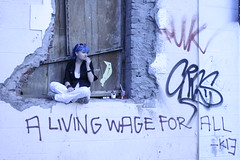
I've commented on the reasons why we should be campaigning for a "living wage" from the student halls of Kings College to the streets of Johannesburg, via the skyscrapers of the City and even across Europe. Friends have been advocating this too and even Obama's new labour secretary, Hilda Solis.

Just reading Mil's post and David Semple's post over at Liberal Conspiracy about regional minimum wages, after San Francisco's decision to increase its minimum wage, it reminded me that we need to push the councils where we live to define what the minimum hourly wage needed to live about the poverty line is - this may be different from city to city (compare London & Liverpool) and region to region (compare the South East and the North East). We also need to get the organisations that employ us to join the growing coalition of "living wage employers".

Obviously, we don’t all have “living wage units” like at the GLA in London, but the “minimum income standard” project run by the JRF provides a well researched measure of how much a worker needs to earn to avoid the effects of poverty, such as ill health, poor levels of child development and social exclusion and not just related to the consumer price index. Calculations can even be made for different family types. Have a look at
http://www.minimumincomestandard.org/cost_calculator/reckoner/index.htm and campaign in your workplace with our toolkit here!

What about the merits of a basic income? Don Paskini blogs that Namibia has introduced this whereby every citizen gets 100 dollars per month without being means-tested. This is paid for through more progressive taxation on those in poverty and higher taxes for those well off. I'm keen to find out more about this and will blog about basic income soon.


Photo by United Workers used under Creative Commons licence.

no one written off? Don't penalise care, reward it


While the progressive flames have been rekindled, we cannot ignore that for those who are being made redundant or repossessed, it's going to be a bitterly cold winter. After binging on the roulette of consumerism to “keep up with the Jones”, people are now struggling to stay even just above water, teetering on the brink of financial and emotional crisis.

The welfare reforms proposed by the government not only proposes to make people work under the minimum wage for income benefits, but the consequences of the reforms will push over the brink many of the people it penalises - parents with young children, carers, disabled people and other vulnerable people.

Credit crunch, social stigma and emotional distress – mixing up a toxic trinity

We make the assumption that focusing on getting people into work helps take people out of poverty – whether it's using the incentive of tax credits and the minimum wage or the threat of cutting welfare payments. But when we look at what's going on the ground, many people find it difficult to find the money or the time to look for jobs. Even when they have found work, many families still face poverty, having to get high cost sub-prime loans because they are refused better value loans. Let's get this straight – the more disadvantaged people are, the harder they're going to be it by the credit crunch.

Many people aspire to be “good families”, but face the constant threat of the windfall companies charging them ever more for their basic needs, with benefits agencies telling them to cut corners when they are no more corners to cut and society labelling them “bad parents”. This all creates a social crisis of of deteriorating mental health and self exclusion.

Income inequality doesn't only affect spending power, it exacerbates everything else – indeed there is a direct correlation between the rates of emotional distress and income inequality. We may be able to reboot the banks at the touch of a Treasury button, but rebooting people's livelihoods requires a far more radical approach.

Start with the soul not with the handbag

It's not because Ken Livingstone isn't Mayor of London anymore that we should stop fighting for free public transport, more social housing or the living wage. But we also need to shift mindsets, we need to look at what people themselves can bring to the table, not just as consumers but as citizens. We need to start with people not with savings, providing the stimulus that revitalises their wellbeing, not just their spending power.

We also need to start changing the arguments. It's not about who is deserving of help or not. It's neither only about defining who is poor or not. It's also about understanding how that poverty is experienced, how people's social and cultural relationships define what they see as their material needs and what they see as socially acceptable - “hard working families” - or not - “benefit scroungers”.

Why do you think so many people want to define themselves as anything other than “working class”? Whatever people think Blair meant by “we are all middle class now”, many people took this to heart because they felt it could take away the social stigma that had lived with them for so long.

People don't want to feel either deserving of fear or pity. Which is why many try and hide away from the helping hand of the state. Which is they become labelled as “hard to reach” or “seldom heard”. Which is why even some of the best services like Sure Start don't reach them as well as they could.


Respect, dignity and hope – nurturing a sense of collective belonging

Recognition and respect are just as important as redistribution. A school which nurtures relationship building is just as valuable as one which nurtures exam success, depending on whether we want to create good little consumers or good citizens.

Recognition that services can be improved by the mutual interests of staff and users working together, not by cutting services. Public services that treat people with dignity, values their contributions and develops a sense of collective belonging.

Although many people find it hard to imagine the possibility of escaping from poverty and social exclusion, that doesn't mean they don't hope. When Obama talks about “being the change we can believe in”, it internalises this paradox very well. Their hopes nevertheless constantly battle against the unpredictability of their lives and the fear it generates.

This is why involving users in co-producing public services doesn't only offer greater hope, it allows people to use this hope and energy to work with staff to develop the services that matter to them.

From consumerist havens to safe spaces – from the customer to the carer

People often look back to a golden age where there was a sense of neighbourliness and people took pride in where they lived. But for some people, when they look at where they live, it's little wonder that they escape to the consumerist haven of the Westfield shopping mall or the virtual meritocracy of the X Factor.

We escape the reality of our neighbourhoods and we escape who we know. We feel we've lost our sense of belonging and our sense of trust. We may feel less trustworthy of our neighbours, less attached to our extended or even immediate families, and yet friendship and trust are even more critical in our increasingly atomised society.

We need to create safe spaces for people to talk and look out for one another through better access to mutual support networks and cheaper relationship counselling. Supporting caring, not penalising it.

Outsourced relationships and hidden assets – towards a “reassuring state”


If what we mean by an “active state” is a state that's reassuring, a state that makes us feel more valued and trusted - as citizens and as public servants - then we need to strengthen the intrinsic values that define the relationship between the state and the people it serves.

Yet through how the the state defines its “services”, public servants can only engage in specific moments in people's lives which ignore the complexities of the rest of their daily life. This creates assumptions by the “state” which are reinforced by people themselves.

Indeed, for many people there is an antagonistic relationship with the state. They feel assessed and judged from all corners – from their neighbours, the media and the state itself. This fuels a vicious circle of avoiding the state to avoid accusations made by others, about whom they make accusations themselves, that they are somehow “cheating the system”. It's not they feel ungrateful, but they feel that the institutions don't understand the realities they live in.

For public servants too, that antagonistic relationship exists, they feel they can't be trusted to serve the public efficiently. The unhealthy compulsion to performance manage, to privatise and to personalise drives them even further away from being able to understand the people they serve.

Rather than continuing to outsource our welfare services with our citizens to companies who we may have to bail out as the recession strikes deeper, we need to re-invest in the emotional and social resources for staff and service users to make the “tough choices” on issues like community cohesion, chronic conditions or climate change. They can work out the tensions between different people's needs and their capacity to participate. Only then can the state show its citizens it is not only “on their side” but working with them “on the same side”.

We need to unlock these “hidden assets” of reciprocity and trust and refashion social capital that values these assets as much as more recognised forms of engagement. Of course we need to get people into work. But that means nothing to the communities we serve if we don't help people help themselves by supporting each other, rewarding care rather than penalising it.

Print some flyers now and hand them out today. Put a poster up in the canteen. Spread the word online straightaway!

Support our "welfare for all" campaign

Click on this link now to add your name to the statement.

We urge you to write a letter to your MP asking them to support our campaign and write a letter to the Work & Pensions Secretary calling for an urgent rethink of the proposals. You can also write in support of the campaign to The Guardian letters page and The Observer letters page.

Images by unusualimage and marcus341 under the Creative Commons license.

what it means to be a young man


On the eleventh day of our South African trip, we returned from Swaziland to Johannesburg, to visit Men as Partners. This is a program that looks at engaging men in reducing gender-based violence and HIV/AIDS.

They go into the townships and recruit men and run workshops on gender. They engage both men and women in constant dialogue and use peer systems to spread their message. They also facilitate workshops on “what it means to be a young man” and a program where older men mentor younger men as positive role models.

Being able to participate in their street interventions was amazing. Seeing someone being able to attract crowds of 20-30 people in the space of half an hour just by mingling at a market stall and showing people a book with pictures of genitalia infected with STDS. They target the streets which are at most risk of gender-based violence. While the crowds gather, they identify those that are the most interested and recruit them to be peer educators in their own areas.

What shocked me however as their AIDS policy, entitled ABY. Abstinence, Behaviour Change and Youth… What was worse was that they only promote condom use to over 18 year olds through “condocans” and “spazashops”. It was unclear whether they thought that it wasn’t appropriate to raise awareness amongst young people or how much pressure had been applied by their main funders USAID, who won’t fund anything which promotes condom use.

let's stop this now

On the tenth day, we went to Swaziland to visit "Swaziland for Positive Living". SWAPOL was started in 2001 for female AIDS survivors and now also focusing on orphans and vulnerable children.

Parents are dying very young which means they cannot be taught family values. Ophans cannot access food and get out abused as so many of them are out of school. In fact, as disheartening as it sounds, education is only free if they can provide the death certificate of their parents and their own birth certificates. Given those conditions are so hard to meet, school registration isn’t very common. So the Friends of Swaziland Trust provide around £40 per child each year, supported by Unite the Union in the UK.

However, on top of that, if the wife is HIV positive, she won’t get the husband’s inheritance, so instead it goes to his brother. So SWAPOL have established law clinics and mobilised widows and orphans to reclaim their homes.

The challenge is incredible for SWAPOL. There are two nurses with one car looking after 365 chiefdoms. So they negotiated with the government to buy medication, supported by the Stephen Lewis Foundation.

On International Women’s Day, they created awareness on grandmother’s programmes, HIV/AIDS, raped young girls and the judiciary, notably pushing the Deputy Prime Minister to make a commitment about the issue of grandmothers. This reminds me of an organisation called Grandparents Plus and the transformational impact that an ageing population can have.

SWAPOL want to work with other players – to raise awareness to companies who own water to improve access, to trade unions to develop their HIV/AIDs programs and spearhead democratisation in Swaziland.

We met with Stephen, who works for Skills Share Development supporting SCCCO. This is a coalition which brings together trade unions, employers, churches and lawyers at the highest level of civil society. It lobbies government on democracy and human rights and uses high level advocacy through the media (including a BBC documentary), which is especially difficult as cannot attack traditional authorities.

Citizenship in most countries is a difficult subject to engage people beyond knowing the difference between institutions. In Swaziland it’s critical to change the culture. SSD provide civic education on how it feels to be a citizen and not a subject. They train around 40 young people and send them to the rural areas they each come from. They empower people to make up their own minds.

Political parties aren’t recognised. To stand for election, you’re invited to stand by the chief who is appointed (and can be expelled) by the king. However, for the elections coming up, by the time SADC and AU observers come, only the loyalists will be in place.

Civil society is riven by rivalries and NGOs are trying to achieve their own ends. The UNDP won’t support the coalition as could be perceived as anti-government. We could argue that they won’t know what civil society needs until they begin that conversation.

Swaziland is in a dire situation. It is second to Zimbabwe in the most unhappiest countries in the world. There has been six years of drought due to the manipulation of access to water. Women and children do not have the right to self-determination. Government spends more on foreign travel than on education. The government has built the country like a rooster, all it would take is a fox to break in.

Go on http://swazimedia.blogspot.com and http://swazisolidaritynetwork.blogspot.com.

A big question for me is how can civic society coalitions campaign on issues (which by definition would criticise government in oppressed states) and be eligible to get international funding? In practice, we know the answer is they can’t as it’s seen as political, but surely it doesn’t make sense and we should be lobbying those international institutions to confront them with this reality?

We need to apply pressure on the EU for how they fund and understand civil society needs in oppressed states. They have done so in the past, for example in Northern Ireland, asking them firstly what the local needs are, then fund projects to help tackle those needs. We need to get the European Union to apply their “peacebuilding” model used in EU member states, to countries outside, particularly in politically oppressed countries.

Where Zimbabwe goes, Swaziland will follow, if we don’t stop this now.

we won't eat rhetoric, we need to eat food


On the ninth day of the South African day, As we walked down the allegedly most dangerous streets of Johannesburg (given all of us were wearing Primani there wasn’t much hope for anyone mugging us), I noticed a graffiti mural of the trade union federation COSATU just outside their headquarters, with a tag on their “living wage campaign”. First London now the world I thought, let’s take this global!

We met the International Secretary of COSATU who gave us the history of the federation, formally established as a non-racial organisation in 1985 mobilising as part of the struggle for freedom with a militant internationalism, as black workers weren’t allowed to bargain until 1980. Before that, they would organise informally within a context of contradictory interests within the anti-apartheid struggle between the SAC who were the leaders of the revolution – “the first to sacrifice, the last to leave” – and the ANC who became the political head of the struggle. Most people joined the trade union movement not through being taught theory but experiencing exploitation.

Now however, many workers do not trust the ANC arguing that “we won't eat rhetoric, we need to eat food”. The trade unionist explained there was a two tier labour market between secure and casualised employment and no legal minimum wage.

A “cappuccino effect” has been created with a sprinkling of black elites at the top covering a mass of white elites. Indeed, blacks still control only about 10% of the Johannesburg Stock Exchange, despite consisting of 80% of the population. Black Economic Empowerment does ensure that there are 50% of blacks in the boardroom, but systematically whites remain as majority stakeholder. Similarly, access to education is still based on apartheid not through law but through income. They were very concerned that if ANC keep going along on the gravy train, they will eventually fall.

They do strongly mobilise with civil society linking up through the Jobs Front, which seems their equivalent to London Citizens.

One of three trade union federations, along with NATU and FETU, they have a membership of 1.9 million members. Their international agenda is articulated through the Programme for Minimum Practice for Working Class Internationalism, focusing on
  • Trade, socio-political and environmental justice
  • Working class solidarity
  • Capacity building

They use a three-pronged approach in campaigning for solidarity
  • strategic analysis of the world: what are the balance forces?

African economies are more closely linked to the West than to each other and in South Africa, raw materials leave the country and finished products return, thus squeezing the economy of its resources. In effect, for every $1 that the West gives in aid, Africa gives $3 back in trade.

technical and operational mechanisms: how can we influence international institutions like the UN, IMF or WTO

They are lobbying internationally against the Economic Partnership Agreements (EPAs). They advised us to challenge trade unions in Europe and the US on this issue to show real solidarity with African workers.

They also argued on the paradox of NGOs. Many respond to priorities developed in the West through a project management approach which makes them more responsive than pro-active and leaves local groups isolated as they don’t fit into the bid frameworks developed by the NGOs.

  • practical projects: solidarity on human rights, health and education – focusing on Burma, Cuba, Nigeria, Palestine, Swaziland, TImor and Zimbabwe

Through acting as a quasi diplomatic arm for the African trade union movement, they can lobby Brussels over EPAs and the role of Chinese companies in Africa and at the same time work with progressive forces across Europe.

They also mobilising in areas where the recent xenophobic attacks took place, organising rallies and delivering leaflets in the various local languages spoken, trying to calm down the tensions and racism. Indeed the worst victims were from Zimbabwe and Mozambique, a country who despite enjoying 8% of economic growth, still suffers from terrible inequality. This brought the question that if Zimbabwe became democratic, there would still be a long journey until there was greater equality. COSATU have applied to work as observers in Zimbabwe, independent of the South African government.

from jobless growth to the living wage


On the eighth day of the South African trip, we met Isabelle and Glen, who came from the NGO and labour movement set up the Studies in Poverty and Inequality Institute in 2006, which very much reminds me of what Compass was like when it first started.

They described how social security reform is currently based on the industrialised version – the assumption of full employment which is why no income support exists. In fact, in South Africa, over 7 million people of working age have no visible forms of income.

Although the government is trying to support to entrepreneurs, it is difficult to identify markets for locally produced goods. Similarly, given the important role women have in the informal economy, when they join government welfare-to-work programmes, when the programme finishes, they are displaced from that informal economy. This brought home to me the question of how can people or groups organise in the informal economy?

With South Africa based on monopolies of social and economic elites, the current macro-economic policy in the country focuses on GDP rather than GIA and therefore reducing state expenditure, resulting in “jobless growth” and a “dual labour market” with increases in shareholder profits as people unemployed (especially young people with 40% out of work).

Indeed, the wider relationship between citizens and the state has dramatically changed. While the shadow of the state threatened the corners of every street in the apartheid years – symbolised through the casspir – nowadays, the shadow of the state is no longer threatening by its presence but in many ways by its absence, especially in the townships.

All of this is happening in the context of growing violence and deteriorating mental health and wellbeing of the population, partly from the lasting effects of the dehumanisation from the apartheid era, but also from the striking inequalities.

There were interesting parallels between the strength of the civil society and the vacuum of provision of public services in townships, but also between that granite strength of the Constitution around socio-economic rights and the anarchic unpredictability in implementing those rights, such as access to water and housing.

As such, there is a feeling by civil society of deep betrayal by the government.

But even civil society is dominated by monopolies, partly through the historic need to centralise to unite against apartheid. They warned that NGOs should be thinking about working themselves out of a job, especially as many of them are from the middle classes and don’t live in the townships. Their understanding of social reality is distanced from where they live themselves.

However, there are exciting groups organising such as the Centre for Policy Development, VITS EPU and the Global Campaign for Education. In terms of policy development, previously this got made at the ANC Congress, but more and more it is about lobbying groups getting their slice of the cake rather than building relationships with individuals and community groups.

They did warn that as long as the ruling class didn’t give a dam, you need a crisis in society for them to react. The commitments are there from the government, but not much has been done.

They argued that as much as they were a campaigning thinktank, it was important they weren’t gatekeepers. They were trying to create spaces for interaction while pushing issues to the top of the agenda, like

  • campaigning for the government to use its 3% budget surplus to introduce comprehensive social security

  • capping higher wages and introducing a living wage

Sounds familiar?

skills race or brain drain

On the seventh day of the South African trip, We met a member of the NEC of the ANC Youth League. I have always had a lot of respect for their struggles and achievement in defeating apartheid. I was keen on finding out how they involve young members in shaping policy, especially in areas of deprivation. I was also interesting in working out how they work with campaigning groups who don’t belong to parties – “the progressive coalition”.

The ANC Youth League is the largest youth organisation in South Africa and historically have always tried to radicalise the ANC. Historically, its most influential leaders have included Oliver Tambo and Nelson Mandela, who in 1962 developed a youth manifesto called the “Programme of Action” that started the civil disobedience campaign that led to Mandela’s imprisonment. The turning point was the Soweto uprising in 1976, where they fought against the government and many were killed. However, this was a watershed for the population that South Africa had to change.

Since the start of the new democracy, they proposed to have a Youth Month every June. This is personified in the Youth Day which commemorates the Soweto uprising on 16th June 1976, but more importantly celebrates the role that young people can play in society. During this day and amongst other youth leaders, the President of the ANC Youth makes a televised address – indeed according to the person we met, they “call the shots in this country”…

The key strategies for the ANC Youth League include

  • Healthy living campaign: encourage young people to delay having sex and to protect themselves, lobbying institutions to find vaccines as well as targeting alcoholism and drug abuse

  • Nation building: building dialogue with other races in South Africa to consolidate a multicultural society

  • Higher education: helping people pay their tuition fees and campaigning for higher education to be free

  • Political education: work with youth leagues in other countries for better democratisation of the society

  • Democratisation: campaign for democratising the judiciary and economy

One of their policies has been to ensure uncompromising gender equity, where 50% of every executive – from NEC to local branch – has to be composed of females. If branches decide otherwise, their elections are nullified. The story behind this is that during the apartheid era, women were discriminated against in a very patriarchal society.

We then proceeded to meet a director of the Department of Constitutional Affairs. Albeit being a senior civil servant, he was dressed in a tshirt and blazer, which really relaxed the atmosphere. He was bombarded with questions about the “skills race” and was true to form. He described how the universities were created to serve the apartheid system before 1994.

When democracy came, a program was created to massify further education. This has narrowed the gap in participation rates between blacks (doubling from 21-43%) and whites (60%), with also 53% women and about 20% of students coming from the wider Southern African region.

Racism is still a determinant and although government don’t want to tamper with high performing universities, a commission has recently been charged with investigating social cohesion in higher education. This is also linked to the gap between teacher and research-based universities. The government encourage differentiation of what services students get from universities, but this has led to universities becoming autonomous, tuition fees varying from £7000 to £20000 rand a year.

Having made those positive inroads into greater equality at HE level, they now want to incentivise greater collaboration with employers, other governments and with SASU. Indeed many students study abroad. For example they are working with Carnegie where students are provided tuition fees on the condition of working in South Africa for the next four years. A good way to tackle the “brain drain”.

However, the state recognises that many private universities – which recruit around 20% of students, mainly people who don’t pass sixth form - don’t make the standard and are particularly keen to improve regulation for foreign universities in setting up local campuses in South Africa. So, they have introduced a skills employment levy, whereby 1% of a company’s profit goes to the levy and a “cola” fund for apprenticeships.

Not being a thorough expert of all things FE and HE, how does this compare with the UK?

csr uncovered


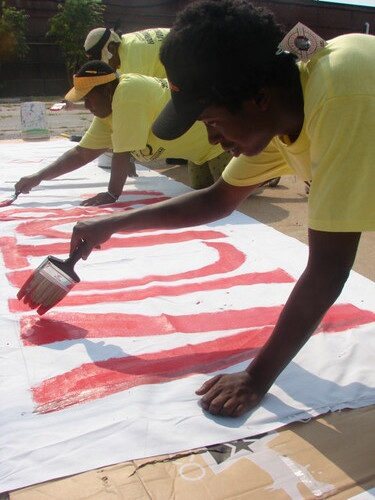
On the sixth day of my South African trip and escorted by the local police, we visited a Children’s Village in the million strong Orange Farm township. We went there to paint their new dormitories, but arriving with our buffet bellies and branded tshirts, we wondered if it didn’t cost more to bring us here as part of a corporate volunteering initiative.

Wouldn’t it have been better to employ local employees to paint and use their skills to develop their own trade?

Should the orphans be lodged in an orphanage so isolated from the local community or should they live with the extended family where they can create networks of trust and build social capital – where they would have the opportunity to find a job in the future?

We then visited a Coca Cola factory. Maybe aware that the majority of youth and student leaders sat around their boardroom were more interested in workers’ rights than profit margins, they started off by telling us about freedom of association and collective bargaining. 71% of their associates are union members, they have a recognition agreement with the main union, they have full-time shop stewards and they hold annual wage negotiations. All permanent associates are entitled to transport allowance and study assistance to further their education which is covered by the company. As well as their company wellbeing program, their HIV/AIDS service provision benefits the “associate” plus one partner and up to 3 children under the age of 21.

So what we found is that the staff benefits were fairly good, but this didn’t cover neither agency nor temporary workers…sounds familiar?

Many of you will be aware of the scandal involving Coca Cola in Colombia. The company itself argued that it was working with the International Labour Organisation on child labour and had developed a guide and principles for suppliers to ensure the supply chain was ethical – something Compass has been campaigning on when lobbying on the Companies Act.

How do we engage constructively with corporate social responsibility projects by companies who we want to hold to account? Do we accept their “goodwill”? Do we refuse contact?

Do we need to engage young people more on corporate social responsibility and how they can play a role in this debate?